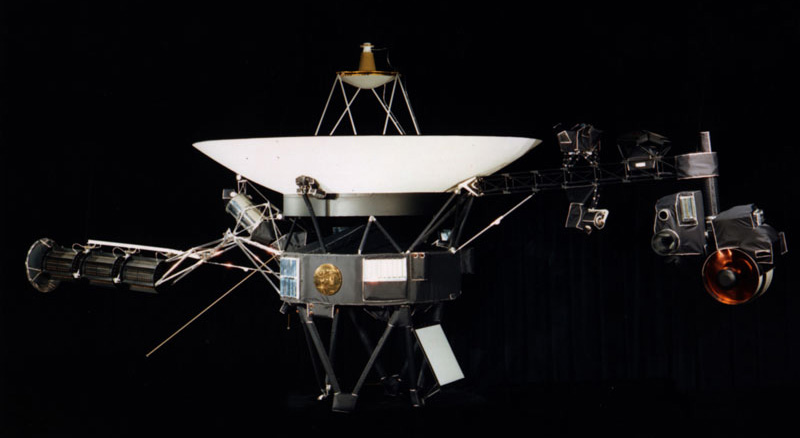
The Voyager probes were two unmanned space probes launched by NASA in 1977 to explore the outer Solar System. The probes were designed and built by the Jet Propulsion Laboratory in California, and launched aboard two Titan-Centaur rockets. Their mission was to explore and map the outer limits of the Solar System, and to send back data about the planets, moons, and other objects they encountered.
The probes traveled for more than four decades, studying the outer planets and their moons, and providing some of the most detailed information available about our Solar System. They also provided the first close-up images of Jupiter, Saturn, Uranus and Neptune, and took some of the earliest pictures of our own planet from interplanetary space.
The Voyager probes have gone on to make some of the most significant discoveries in the history of space exploration. They discovered numerous new moons, and revealed the complex atmospheres and weather patterns of the outer planets. They also identified the first active volcanoes beyond Earth, and provided evidence of an ocean beneath the icy surface of Jupiter's moon, Europa.
The Voyager probes are still continuing their journey, and are now more than 11 billion miles from Earth. They are the farthest man-made objects from our planet, and are still sending back valuable data and images to scientists on Earth. They are expected to continue their mission for many more years, providing us with an invaluable view of our Solar System and beyond.
The Voyager probes were created to explore the outer planets of our solar system—Jupiter, Saturn, Uranus, and Neptune. The probes were tasked with gathering data on the planets and their moons and taking pictures of them, which they did with great success. They also studied the magnetic fields of the planets and detected a number of previously unknown moons.
The probes were launched on a journey of a lifetime with the hope that they would make it to the outer planets. After a successful launch, the probes were sent on a trajectory that would take them past the inner planets, eventually reaching the outer planets.
The probes journeyed for over a decade, covering billions of miles of space. Along the way, they made many incredible discoveries about our solar system and beyond. They discovered new moons and rings around the outer planets, as well as a vast amount of new data about the planets and their atmospheres.
The probes also completed a flyby of the planet Pluto, giving us the first close-up images of the distant world. Finally, after an incredible journey, the probes reached the outer planets and continued to send back data until the late 1990s.
Today, the Voyager probes are still sending back data,

If interested more in space exploration, you can also read another very amazing blog on this topic by clicking the link below:
https://spacetalksspark47.blogspot.com/2023/01/exploring-final-frontier-argument-for.html