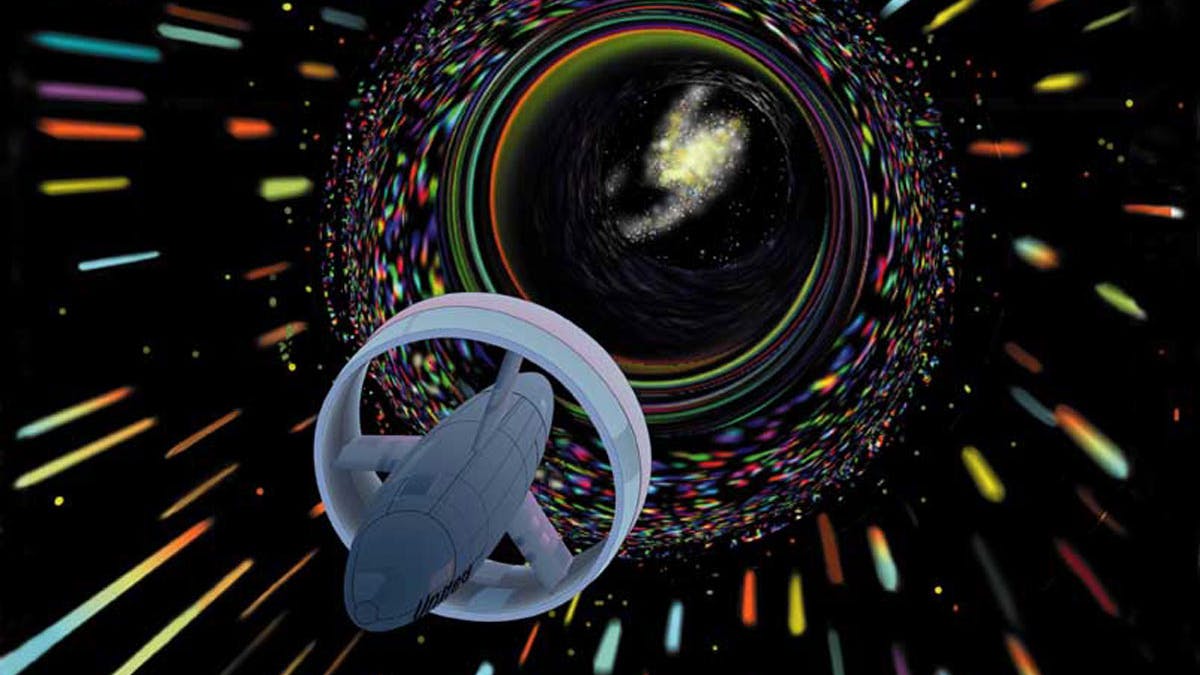
The helical engine is a type of reaction engine, characterized by its unique design. Unlike conventional rocket engines, which rely on thrust produced by burning a fuel, the helical engine uses a rotating magnetic field to produce thrust. The magnetic field is generated by a series of coils that are arranged in a helix shape, which is essentially a spiral. This engine is extremely efficient, and has the potential to reach speeds far exceeding those of a traditional rocket engine.
Theoretically, reaching the speed of light is possible with a helical engine. However, it would require an extremely powerful magnetic field, and the amount of energy required to generate such a field would be immense. Additionally, the helical engine would need to be designed with a low-drag body, in order to minimize air resistance. This would allow for greater acceleration, and thus a higher speed.
To create a spacecraft with a helical engine that can reach the speed of light, the design must first account for the immense power requirements. The engine must also be positioned properly, so that the electromagnetic forces generated by the coils are aligned with the direction of thrust. Additionally, the spacecraft must be equipped with a lightweight frame to minimize drag, and the design must also include a heat shield to protect the vehicle from extreme temperatures. Finally, the engine must be designed to be able to sustain the high-speed acceleration required to reach light speed. With the right design and powerful enough engine, the speed of light could be achieved with a helical engine.
Designing a spacecraft that can reach the speed of light is a complex task, but it is possible. To begin, it is important to understand the physics of light, including the relationship between mass and speed. The speed of light is a product of the ratio between the mass of an object and its velocity. In order to achieve the speed of light, the spacecraft must be able to reduce its mass to the bare minimum.
To do this, the spacecraft needs to use advanced materials such as carbon nanotubes or graphene. These materials are incredibly lightweight and strong, allowing the spacecraft to support its own structure while also reducing its total mass. Additionally, the craft must also be equipped with powerful engines that can generate enough thrust to overcome the limitations of its mass. These engines could be based on existing propulsion systems such as ion engines, or they could be something more advanced.
The spacecraft must also be equipped with a navigation system that can accurately monitor its position and provide real-time updates to the control center. This system would have to be highly accurate, as even a slight miscalculation could be catastrophic. Furthermore, the spacecraft should also be fitted with a powerful communications system that can relay information from its position back to earth.
In conclusion, designing a spacecraft that could reach the speed of light is a challenging task, but it is possible with the right materials, engines, navigation systems, and communication systems. With the right combination of these elements, a spacecraft can be designed that can safely and accurately reach the speed of light.

The Warp Drive: A Revolutionary Spacecraft by NASA
NASA has recently unveiled its revolutionary new spacecraft, the Warp Drive. This revolutionary new spacecraft is said to be the next step in space exploration and an important part of humanity's future.
The Warp Drive works by using a combination of traditional thrusters and a new propulsion technology known as the warp drive. This new propulsion system is said to be able to reach a speed of 30,000 km/s, faster than any other form of propulsion currently available. The drive works by creating a “bubble” of space-time around the craft, allowing it to travel faster than the speed of light, effectively collapsing the space-time continuum and allowing the craft to traverse large distances in a short amount of time.
The Warp Drive has already been tested on a number of NASA's probes, and the results have been particularly promising. The probes have been able to reach speeds ten times faster than any other means of propulsion currently available. The Warp Drive also has a much lower power requirement than traditional means of propulsion, making it a much more efficient option for space exploration.
NASA is currently working to make the Wrap Drive a viable solution for human travel. The Warp Drive is said to be much safer than traditional means of propulsion, and could potentially be used to travel to distant stars and galaxies in a much shorter amount of time than before.
The Warp Drive is a revolutionary new technology that could change the way space exploration is done. It has the potential to revolutionize the way space travel is done, and could prove to be an important step forward for humanity. With the Wrap Drive, humanity may be able to explore the universe in ways that were never before possible.