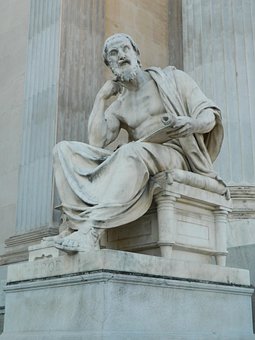
The cosmos, or the universe as we know it, has been a topic of fascination and speculation for philosophers throughout history. From ancient Greek philosophers to modern-day thinkers, each has had their own unique perspective on the nature of the cosmos. In this article, we will explore the viewpoints of some of the most influential philosophers throughout history on the cosmos.
Ancient Greek philosophers such as Aristotle and Plato believed that the cosmos was finite and geocentric, meaning that the Earth was at the center of the universe. They believed that the stars and planets were embedded in crystalline spheres that rotated around the Earth. However, Aristarchus of Samos challenged this view, proposing a heliocentric model in which the Sun was at the center of the universe, and the Earth and other planets orbited around it.
In the medieval period, Islamic philosophers such as Al-Farabi and Ibn Rushd built upon the ideas of Aristotle and proposed that the universe was eternal and infinite, with no beginning or end. They believed that the cosmos was governed by natural laws that could be understood through reason and observation.
During the Renaissance, European philosophers such as Nicolaus Copernicus and Galileo Galilei challenged the geocentric view of the cosmos and proposed a heliocentric model. Copernicus' model was based on the work of Aristarchus of Samos, and he argued that the planets, including Earth, orbited around the Sun. Galileo, using the newly invented telescope, observed that the Moon had craters and mountains, challenging the prevailing view that the Moon was a perfect sphere.
In the 17th century, philosopher René Descartes proposed that the universe was made up of two substances - matter and mind. He believed that matter was extended and had no mind or consciousness, while mind had no extension and was not subject to the laws of physics. He also believed that the universe was deterministic, meaning that everything that happened was predetermined by the laws of nature.
In the 18th century, philosopher Immanuel Kant proposed that the universe was a product of both empirical observation and innate knowledge. He believed that the mind had a structure that allowed it to organize sensory information, which in turn allowed us to perceive the world around us. He also proposed that the universe was governed by a set of moral laws that were inherent in human reason.
In the 19th century, philosopher Friedrich Nietzsche challenged the prevailing view of the cosmos as an orderly, rational system. He believed that the universe was fundamentally chaotic and irrational, and that human beings needed to create their own values and meanings in life.
In the 20th century, philosopher Martin Heidegger proposed that the cosmos was not a mere object of study, but was intimately connected to human existence. He believed that human beings were thrown into the world, and that our understanding of the world was shaped by our individual experiences and interpretations.
Finally, in the present day, philosophers continue to explore the nature of the cosmos, with some proposing that the universe may be part of a larger multiverse, while others argue that the universe is a simulation or a product of human consciousness.
In conclusion, the cosmos has been a source of fascination and speculation for philosophers throughout history. From the ancient Greeks to modern-day thinkers, each has had their own unique perspective on the nature of the universe. While their views may differ, they all share a common desire to understand the cosmos and our place within it.