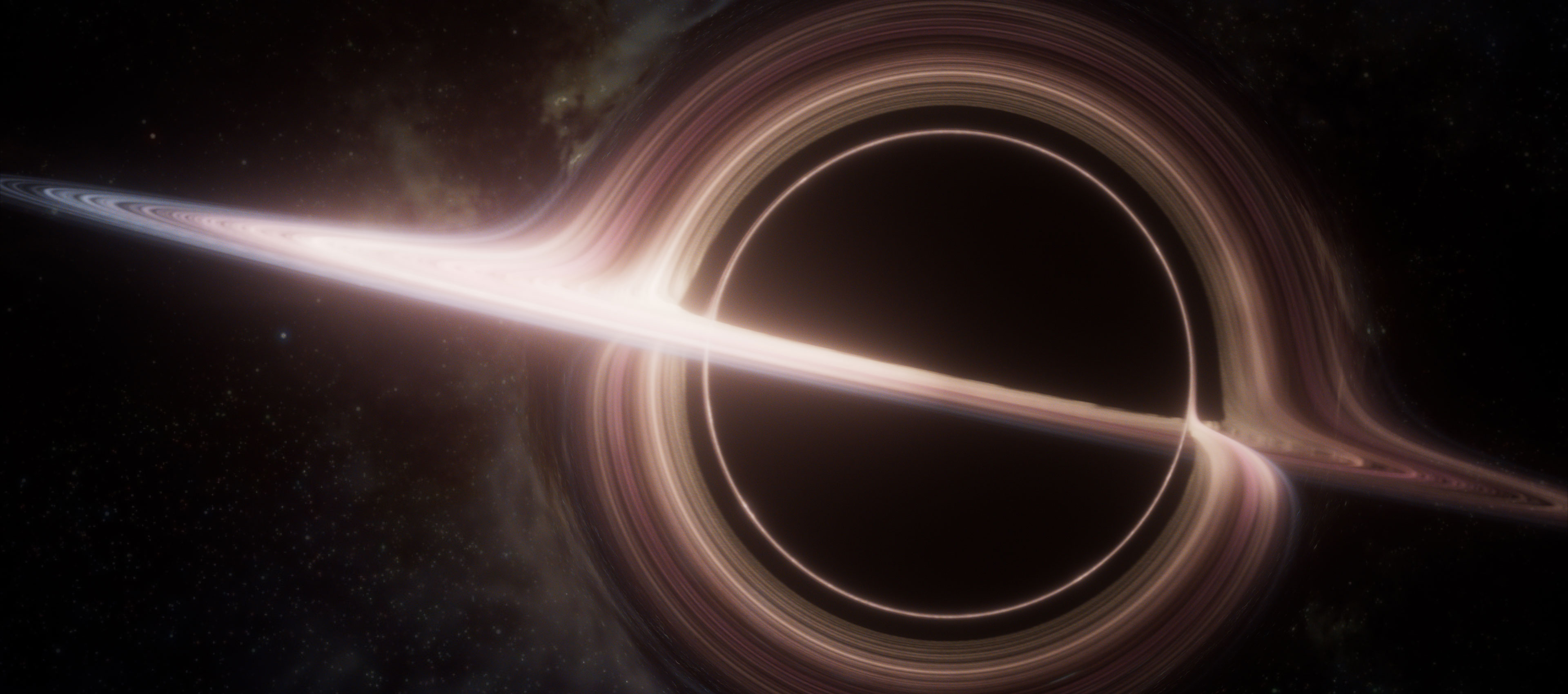
A black hole is an object whose gravitational pull is so intense that nothing, including light, can not escape it.The gravity is so strong because matter has been squeezed into a tiny space.Black holes are the largest single objects in the universe, many times larger than even the biggest stars.
TYPES OF BLACK HOLES:
There are four types of black holes
1 stellar

Stellar black holes form when the center of a very massive star collapses in upon itself. This collapse also causes a supernova.These blackholes are very difficult to detect.
2 intermediate

As the name implies, intermediate-mass black holes are present between stellar-mass black holes and supermassive black holes. They are not too small nor too big. But it is also rare.
3 supermassive
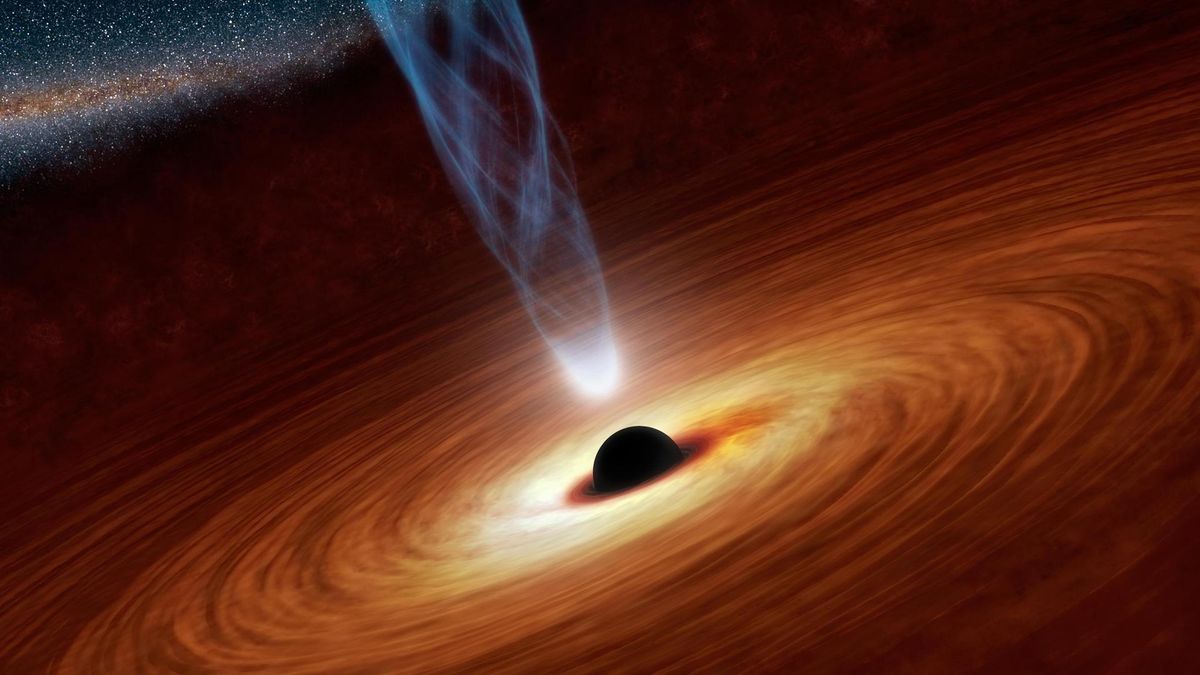
The largest black holes are called "supermassive." These black holes have masses that are more than 1 million suns together.
4 miniature.

Rapidly expanding space may have squeezed some regions into tiny, dense black holes less massive than the sun.
HOW ARE BLACK HOLES FORMED:
A black hole could be formed by the death of a massive star. At the end of a massive star's life, the core becomes unstable and collapses in upon itself, and the star’s outer layers are blown away. The crushing weight of constituent matter falling in from all sides compresses the dying star to a point of zero volume and infinite density called the singularity.
WHO DISCOVERED BLACK HOLES:
Black holes were first identified in Einstein's general relativity. Karl Schwarzschild further envisioned it as a spherical volume of warped space surrounding a concentrated mass and completely invisible to the outside world. envisioned as a spherical volume of warped space surrounding a concentrated mass and completely invisible to the outside world. envisioned as a spherical volume of warped space surrounding a concentrated mass and completely invisible to the outside world.
ARE BLACK HOLES A THREAT TO US:
NO, we are not in a zone of danger as the nearest black hole Gaia BH1 is about 1,566 light years away from us.
/cloudfront-eu-central-1.images.arcpublishing.com/prisa/WI4N7RFNDBEWZCSOPTPRJTDDDI.jpg)
CONCLUSION:
Blackholes are super fascinating objects in space that are formed when massive stars collapse in on themselves. They're so dense that nothing, not even light, can escape their gravitational pull. The region around the black hole where its gravitational pull is strong enough to trap light is called the event horizon.
There are three types of black holes: stellar, intermediate, and supermassive. Stellar black holes are formed when really big stars collapse in on themselves. Intermediate black holes are thought to be formed from smaller black holes merging together, and supermassive black holes are at the center of most galaxies, including our own Milky Way.
Black holes can't be seen directly because they don't emit any light, but they can be detected through their effect on nearby matter. When matter falls towards a black hole, it heats up and emits radiation, which can be detected by telescopes and other instruments.
The gravitational pull of black holes also causes nearby stars to move in unusual ways, which can be detected by astronomers. Black holes have a big impact on the universe, playing a crucial role in the formation and evolution of galaxies. Supermassive black holes are particularly important in this regard, as they're found at the center of most galaxies.